



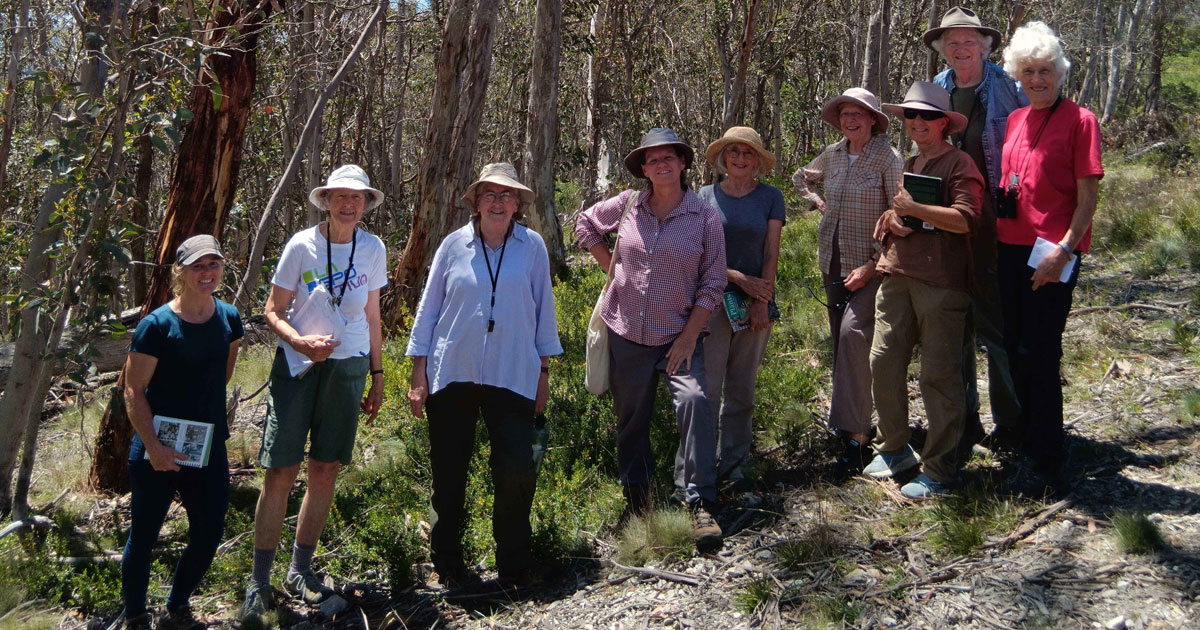
 Plant Study Group at Mt Bindo (Malcolm Hughes)
Yearly programs (with reports from outings where available):
2026 2025 2024 2023 2022 2021 2020 2019 2018 2017 2016 2015
The BMCS Plant Study Group (PSG) generally meets on the second Saturday of each month and travels to different locations in the Blue Mountains. Before attending for the first time please contact Genevieve Powell by email at genevievepowell99@gmail.com. Changes to the program appear in red.
Plant Study Group 2026 Program
Notes: * Outing is a week earlier than usual. ** Additional outing.
| 28 Jan | Blue Mts. Botanical Gardens Bus trip, Mt. Tomah Don Cameron in conjunction with staff leader report |
| 14 Feb | Fairfax Heritage walk, Blackheath Helen Yoxall report |
| 14 March | Coates Park Bushcare group, Hazelbrook Bushcare Group contact Susan Jalaluddin & Meredith Brownhill report |
| 11 April | Adeline Park, Faulconbridge Jo Newman & Genevieve Powell report |
| 9 May | Thirlmere Lakes National Park bus trip Meredith Brownhill report |
| 13 June | Adams Lookout, Hazelbrook Genevieve Powell & Jo Newman report |
| 11 July | Yondell Ave. Fire trail, Springwood Helen Yoxall report |
| 8 August | Rookwood Cemetery (bus outing) Alison Hewitt |
| 12 Sept | Murphys Glen, Woodford Jelena Emmerick |
| 10 Oct | Anvil Rock, Blackheath Janice Hughes |
| 14 Nov | North Katoomba Lyndal Sullivan |
| 12 Dec | PSG Christmas lunch - TBA |
Possible Events: Newnes Plateau Swamp, BMCC Bushcare groups
2026 Reports (click image to see a larger version)
13th July 2026 - Yondell Ave. Fire trail, Springwood
On a lovely sunny winter’s day, 15 Group members walked part of the Yondell Avenue Fire Trail through the woodland of the Sassafras Gully Reserve at Springwood.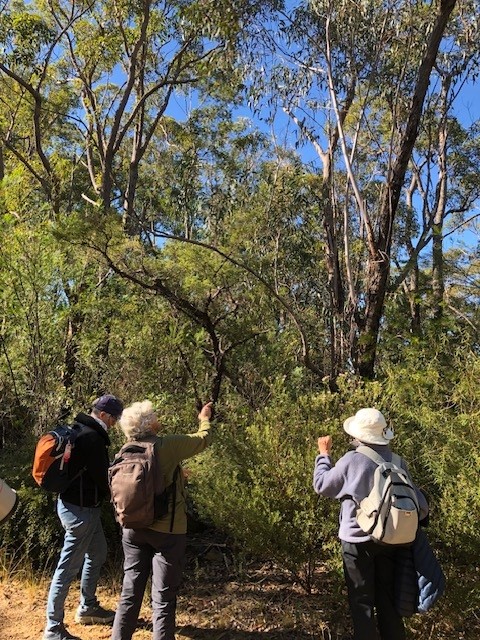 Plant Study Group considering Eucalyptus consideniana (Helen Yoxall)
Wattles were a feature of the day, with Acacia decurrens, A. echinula, A. linifolia, A. longifolia, A. parramattensis, A. parvipinnula, A. suaveolens, A. terminalis and A. ulicifolia all recorded. We paid particular attention to inflorescence type, gland position and bark colour as key identification features.
Eucalyptus consideniana was observed, a relatively new species for the Group. It is a half-barked species that closely resembles E. piperita, but can be distinguished by its fruit, which is conical/pyriform in E. consideniana and globular in E. piperita.
The root hemiparasite Olax stricta was in flower. In our nutrient-poor soils, parasitism may give these plants a competitive advantage where phosphorus and nitrogen are scarce.
One disappointment for us was the profusion of the weed Eragrostis curvula (African Love Grass), which now seems to line most fire trails in the Mountains.
Also in flower were Conospermum longifolium, Grevillea mucronulata, Hakea sericea, Leucopogon muticus and Xanthosia pilosa. The spent flowers of a Corunastylis (Midge Orchid) were also seen.
Leader & Report: Helen Yoxall
Photo: Plant Study Group considering Eucalyptus consideniana (Helen Yoxall)
13th June 2026 - Adams Lookout, Hazelbrook
On a beautifully clear winter’s day 12 enthusiastic Plant Study Group members met to walk and explore the plants along the mostly flat and at one part slightly sloping terrain to Adams Lookout. .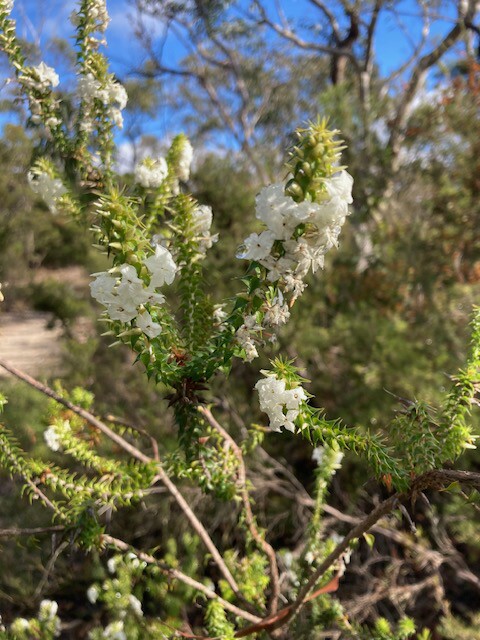 Woollsia pungens (Genevieve Powell)
A variety of habitats were evident along the way including woodland, partially open forest, and swamp . The vegetation is typical of the mid mountains ranging from Epacris microphylla, Leucopogen setiger with its lovely white floral tubes, a variety of acacia including Acacia teminalis with its bipinnate leaves paler on the underside and its globular flowers well-spaced growing from the upper leaf axils, Corymbia gummifera, Angophora costata, Eucalyptus racemosa and other Eucalypts.
A number of grasses were seen on the day including Cymbopogon refractus, Digitaria parviflora, Echinopogon caespitosus, Echinopogon ovatus, Microlaena stipoides and Oplismenus aemulus .
Leader and Report: Genevieve Powell
Photo: Woollsia pungens (Genevieve Powell)
9th May 2026 - Thirlmere Lakes National Park
Our visit to Thirlmere National Park in the Greater Blue Mountains World Heritage Area was a celebratory visit for the 25th anniversary of World Heritage in 2025.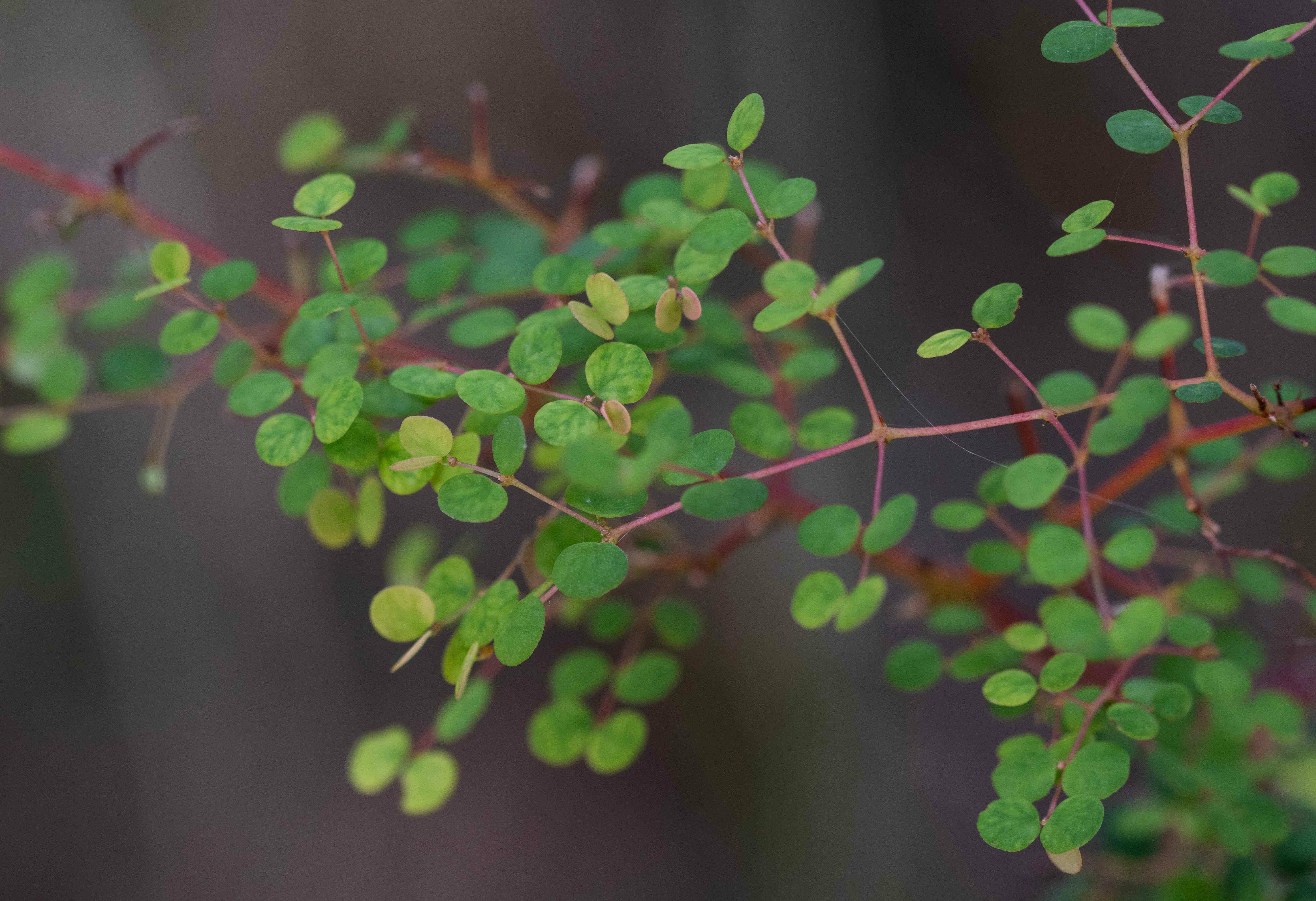 Bossiaea lenticularis
 On the way there, we visited Burragorang lookout with spectacular views of Burragorang Valley extending west through the water catchment and World Heritage Area. Lovely smooth bark Eucalypts were at the lookout.
Thirlmere Lakes’ formation is quite unique and we were fortunate to be here with water in the lake system. Findings of research by UNSW concluded that the lakes are controlled by the climate and that they are reliant on catchment rainfall.
So the ecosystem is vulnerable and has three Endangered Ecological Communities (EEC) with threatened plant and bird species. The EEC of particular interest to us was the Lepironia Freshwater Wetland with the tall rush Lepironia articulata which has limited distribution in NSW. Melaleuca linariifolia was present with a diversity of sedges.
Back from the water we walked under an open canopy of Angophoras, Corymbias and Eucalypts with a healthy understorey of Proteaceae species. Other plants of interest were Acacia filicifolia and Bossiaea lenticularis.
We ate our lunch at picnic tables on the peaceful shores of the lake and mid-afternoon our volunteer bus driver took us all home after a splendid day out.
Leader & Report: Meredith Brownhill
Photo: Bossiaea lenticularis - Fiona Vaughan
11th April 2026 - Adeline Park, Faulconbridge
A well-attended walk with 15 members on a sunny autumn day exploring the ridgetop woodland of Adeline Park, part of the Linden Creek Catchment.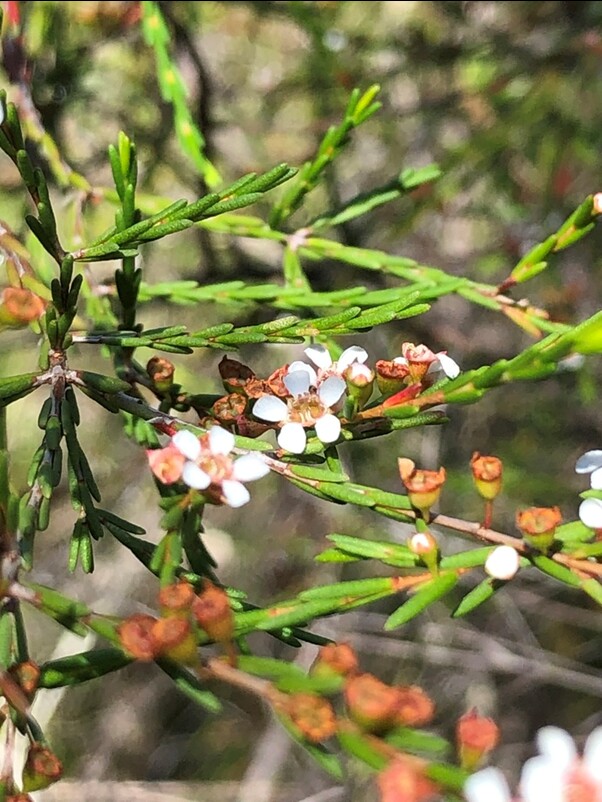 Harmogia densifolia
 Of particular interest on this walk was Eucalyptus burgessiana (Faulconbridge Mallee Ash), whose type specimen was collected here by Laurie Johnson of the Royal Botanic Gardens and Rev. Colin Burgess in 1953. (Burgess was rector of St Albans Leura, 1944-56 and in 1963 wrote the local handbook Blue Mountains Gums. He later worked as a botanist at the Australian National Botanic Gardens.)
In flower we saw Hakea propinqua, Pultenaea tuberculata, Leucopogon microphyllus, Banksia spinulosa, Platysace linearifolia, Bossiaea heterophylla, Woollsia pungens, Lepyrodia scariosa, Actinotus helianthi and A. minor. The prolific Acacia oxycedrus which we saw in bud will be a delight in Spring.
Two heath myrtles, Harmogia densifolia and Baeckea brevifolia, growing side by side, caused initial confusion, sorted by closer observation and consultation of our floras.
Leader: Jo Newman
Report: Helen Yoxall
Photo: Harmogia densifolia - Helen Yoxall
14th March 2026 - Coates Park, Hazelbrook
A sunny autumn day raised group expectations in finding a good diversity of plants in Coates Park. At the start of the track we did tuck our long pants into our socks to protect ourselves from any hungry leeches! Then we stayed on a narrow track through swamp surrounded by the large dominant rush, Schoenus melanostachys.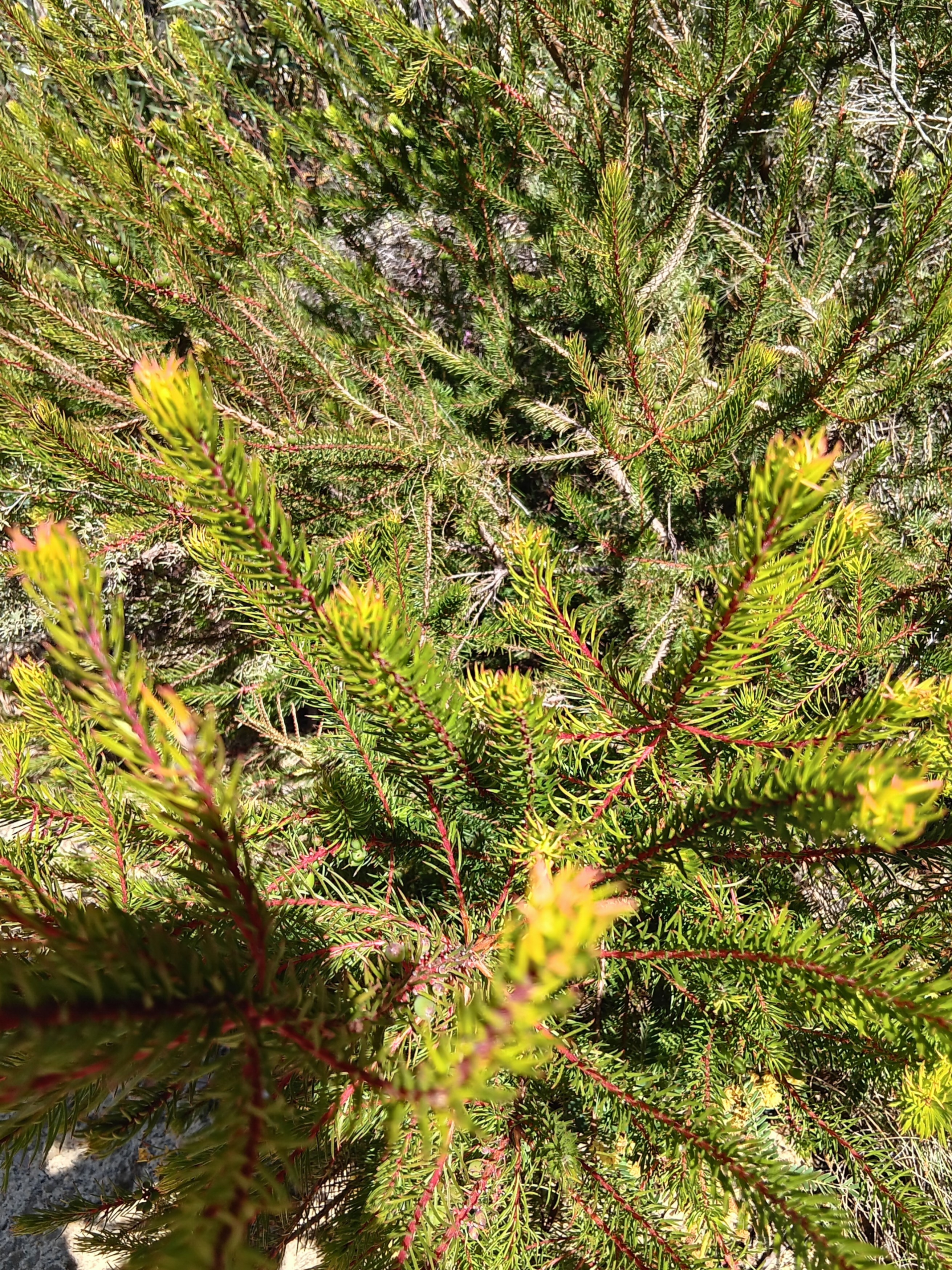 Persoonia acerosa
 Coates Park is a council reserve, with protected vegetation under the Local Environment Plan 2015 i.e., B.M. Heath & Scrub and B.M. Swamps being present. Also, council mapping shows Corymbia gummifera and Eucalyptus sieberi Open Forest as being present. Additional Eucalypts formed the open canopy for vigorous Proteaceae shrubs such as the Persoonia species.
Persoonia acerosa was a plant of interest, as it is a rare and listed Endangered species. It has very narrow leaves, acerosa, coming from the Latin acerosus meaning ‘needle-shaped’. The plants are killed by fire and recruitment is only from seed. So hazard reduction and bushfire are one of its threats.
It was a delight to see orchid leaves emerging beside the track. We ate our lunch sitting on a log, surrounded by a splendid diversity of plants and then returned back along the track
Leader and report: Meredith Brownhill
Photo: Persoonia acerosa - Meredith Brownhill
14 February 2026 - Fairfax Heritage walk, Blackheath
Nine members arrived at the Blue Mountains Heritage Centre in wet and misty conditions. We watched some audiovisual displays in the Auditorium, visited the bookshop and set off on our walk when the weather improved a little.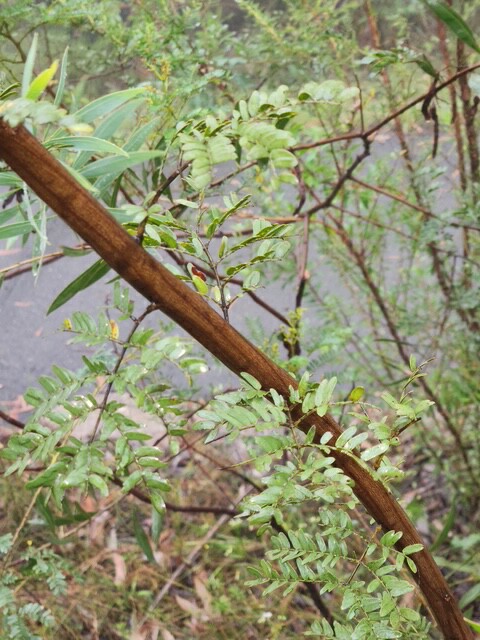 Acacia rubida Blackheath
The track, which was constructed in the mid 1980s, goes to Govetts Leap lookout via a woodland dominated by Eucalyptus piperita, E. sieberi and E. racemosa ssp. racemosa. Also at the site is E. radiata.
The shrub and herb layers of the woodland are very diverse. We particularly noted Daviesia ulicifolia, Gahnia clarkei, Grevillea laurifolia, Haemodorum planifolium, Hakea teretifolia, Persoonia myrtilloides, Polyscias sambucifolia and Acacia rubida. The latter is unusual in that some bipinnate juvenile leaves persist on the plant, as evident in the photo. Most species of Acacia with phyllodes (modified stems) have no juvenile leaves beyond the seedling stage.
Along the way, there were some good-humoured disputes about the pronunciation of botanical names. Should the “c” in ericifolia be hard or soft? Ought we to say “Lambert-ee-a” to properly honour Mr Lambert instead of the usual “Lambersha”? Things got too serious when the discussion turned to the French “au” in the name of botanist Gaudichaud-Beaupré and the Latin “au” in the name of the new tea tree genus Gaudium – at which point we wisely abandoned the subject altogether!
Leader: Helen Yoxall
Report: Helen Yoxall and Don Cameron
Photo: Acacia rubida by Don Cameron
28 January 2026 - Blue Mountains Botanic Garden
This outing was a mid-week bus trip. Ashley Filipovski, the Curator Manager of the Blue Mountains Botanic Garden Mount Tomah, took us on an extensive tour of the botanic garden itself and the tall wet forest juxtaposed with it. Both areas have superb plant assemblages, with the magnificent Eucalyptus fastigata Brown Barrel as the dominant species.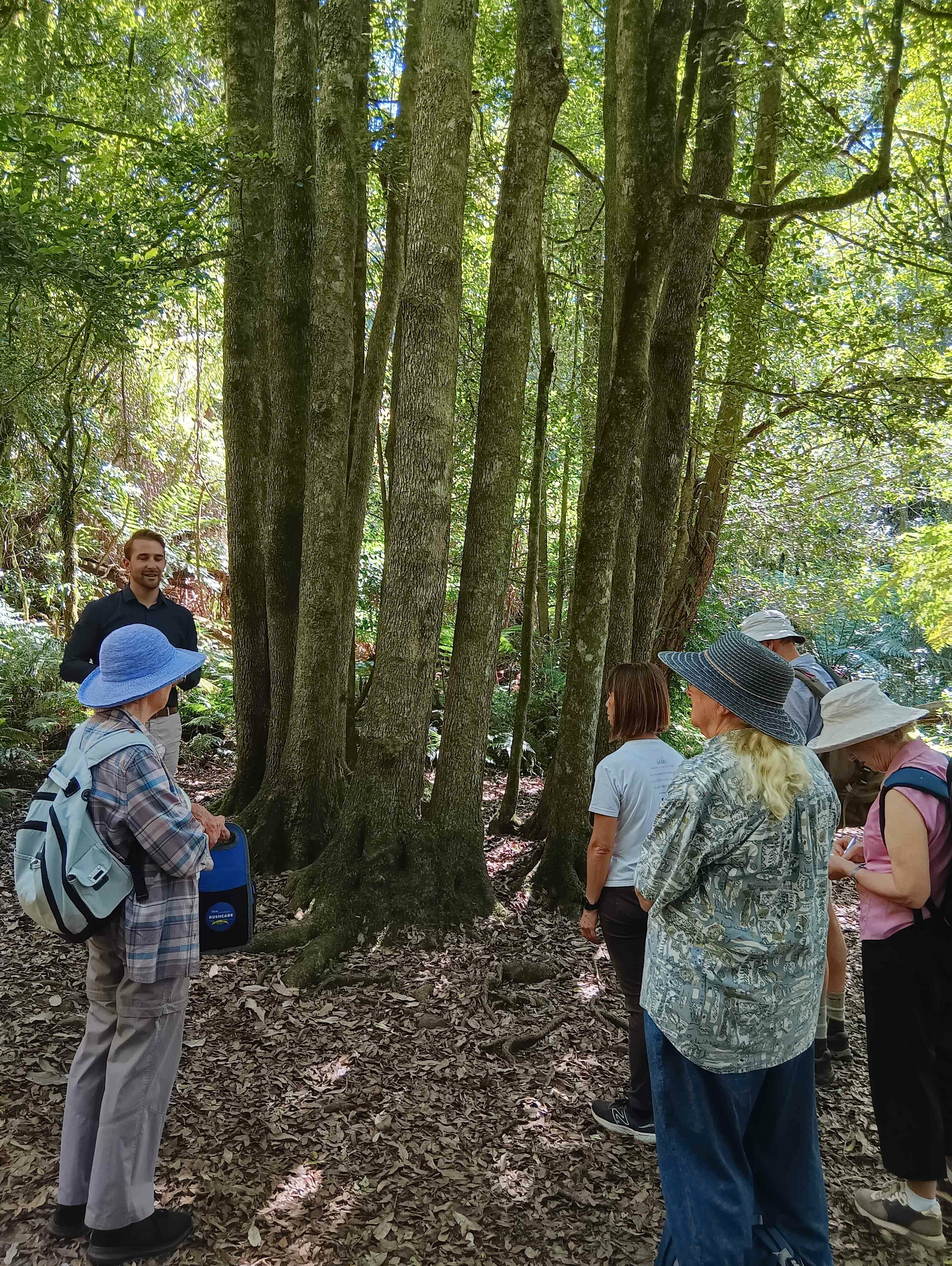 Doryphora Sassafras Mount Tomah (Meredith Brownhill)
Another common tree in the native forest is Doryphora sassafras Sassafras, the tree in the photo. The ten or so ring of trunks in the foreground are all the same ancient tree. There was once a massive trunk at the centre of the ring, and the younger trunks grew from the periphery of its root system.
Ash provided expert commentary on the increasing role of the garden in nature conservation, the ongoing installation of a sprinkler system to protect against bushfires, the differences between French and English formal gardens, and other topics. All in all, the outing was very enjoyable and educational.
Leader: Don Cameron
Report: Don Cameron
Photo: Doryphora sassafras by Meredith Brownhill

We acknowledge the traditional custodians of this land
the Darug and Gundungurra people
and pay respect to their Elders past and present.