



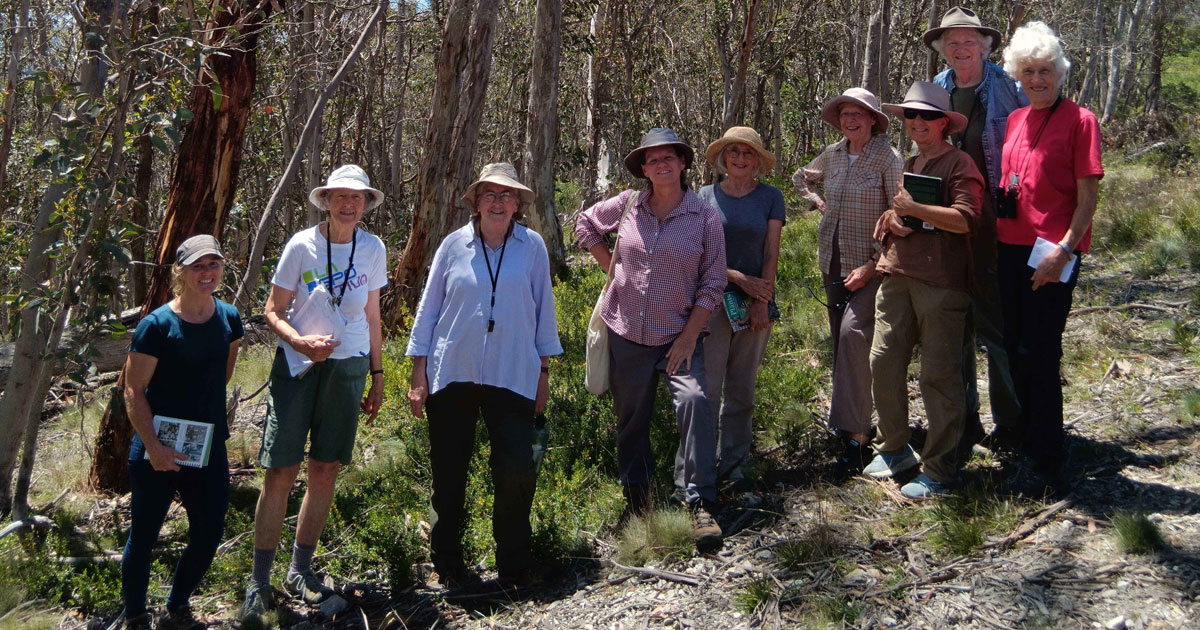
 Plant Study Group at Mt Bindo (Malcolm Hughes)
Yearly programs (with reports from outings where available):
2026 2025 2024 2023 2022 2021 2020 2019 2018 2017 2016 2015
The BMCS Plant Study Group (PSG) generally meets on the second Saturday of each month and travels to different locations in the Blue Mountains. Before attending for the first time please contact Meredith by email at mountains@westnet.com.au. Changes to the program appear in red.
Plant Study Group 2025 Program
Notes: *Outing is a week earlier than usual. **Additional outing.
| 11 Jan | Perry’s Lookdown, Blackheath Janice Hughes report |
| 8 Feb | Ikara Ridge, Mt Victoria Jo Newman report |
| 22 Feb | 1-3 pm: Sun Valley Cabbage Gum Forest with Bushcare Group report |
| 8 Mar | Deidre’s Walk, Kent St., Bullaburra Lesley Gersen |
| 12 Apr | Mt Annan Botanic Gardens Bus trip Peter Cuneo & Meredith Brownhill report
* site tour and garden history on the bus * walk through Cumberland Plain Woodland conservation area * Plantbank brief overview * Connections Garden overview |
| 10 May | 20th PSG Birthday - the Nature Walk, Wentworth Falls & joint twentieth celebration. Alison Hewitt report |
| 24 May | 1:30-33:30 pm:Coates Park Bushcare Group, Hazelbrook report |
| 14 Jun | Glen Davis. Capertee Valley bus trip Meredith Brownhill report |
| 12 Jul | West Glenbrook Nature Reserve Jill Dark report |
| 9 Aug | Cancelled due to rain |
| 13 Sep | South Woodford Jelena Emmerick report |
| 11 Oct | Banksia View vegetation survey Winmalee (PSG members only) Margaret Baker report |
| 8 Nov | Hassan’s Walls - Lithgow Meredith Brownhill report |
| 29 Nov | Maiyingu Marragu - Lidsdale Meredith Brownhill report |
| 13 Dec | Christmas lunch Gordon Falls, Leura - Helen Yoxall report |
EXTRA EVENTS:
| Open | Gill & Neal have invited us to Hampton for lunch - TBA |
| Open | Dantes Glen, Wentworth Falls with Bush care Group 3rd Saturday/ month |
2025 Reports (click image to see a larger version)
13 December - Gordon Falls, Leura
We started the day by setting up our picnic tables in readiness for our Xmas lunch. Then fifteen of us walked along the cliff top track identifying a diversity of plants.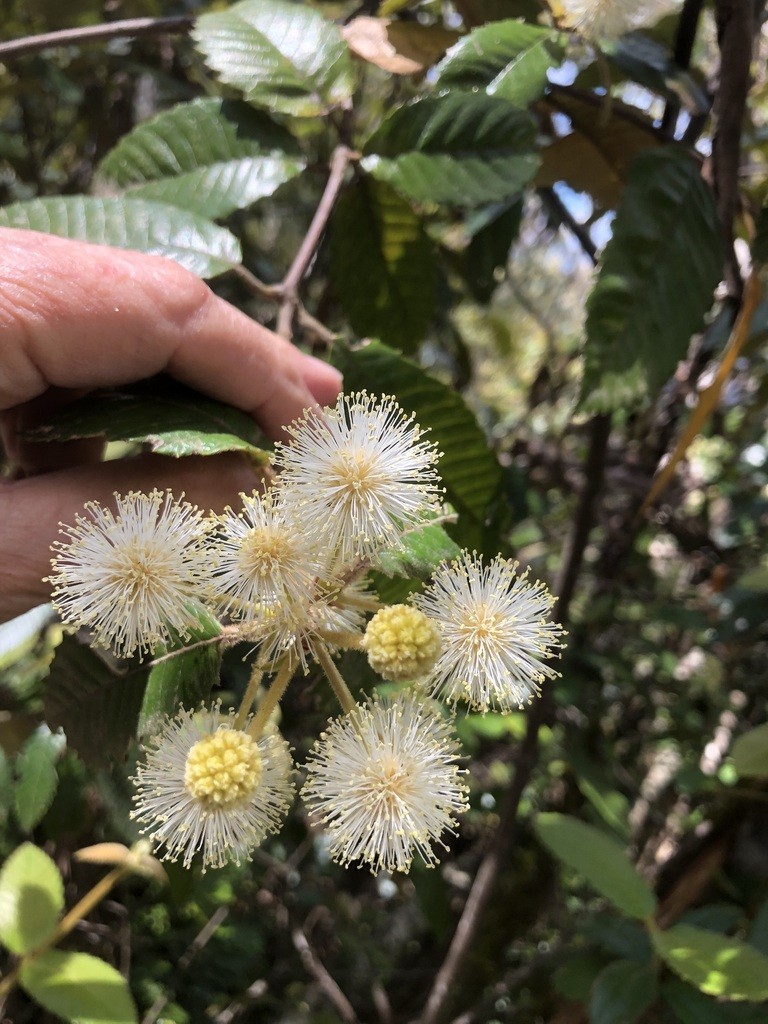 Callicoma serratifolia Leura Cliff-top (Helen Yoxall)
Morning tea was at Elysian Rock where we enjoyed the spectacular view across the Jamison Valley to Mount Solitary, Narrowneck and beyond.
Being right on the cliff edge with a southern aspect we found rainforest trees, such as Callicoma serratifolia, also called Black Wattle even though it is not an Acacia. There were some Proteaceae shrubs from the sandstone plateau, as well as some shrubs endemic or rare to the area.
Eucalyptus dendromorpha is a rare mallee in the area, taller and found along the southern escarpment tracks. Another unique plant to the wet cliff edges is Dianella tenuiisima, with purple berries that helped identification. Goodenia decurrens is another species that favours wet cliffs.
We finished the year with a delicious healthy shared lunch, some Achievement Awards were given out and we made plans for 2026. Helen spoke and on behalf of the group made a presentation to Meredith in appreciation of her enormous contribution to the Group in her many years as our Coordinator.
Leader: Helen Yoxall
Report: Meredith Brownhill
Photo: Callicoma serratifolia by Helen Yoxall
29 November - Maiyingu Marragu, Lidsdale
Maiyingu Marragu is an Aboriginal Place of the Wiradjuri Nation with cultural significance. Ancient rocks, ceremonial caves and pagodas on the skyline were awe inspiring.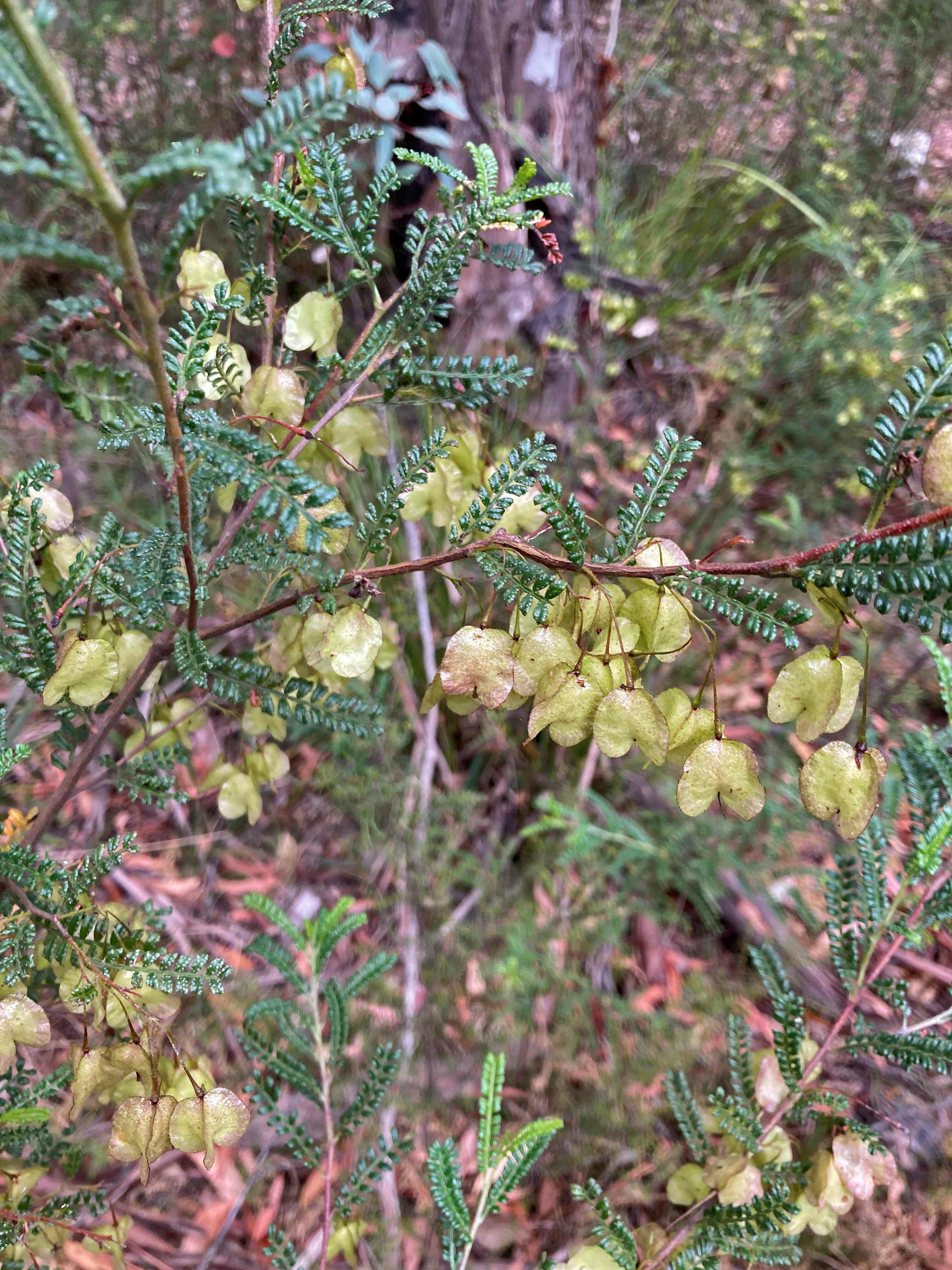 Dodonaea multijuga Maiyingu Marragu (Jill Dark)
The vegetation was diverse Eucalypt Woodlands, a special reminder that this significant Eucalypt diversity contributed to our Blue Mountains World Heritage listing – this year being our 25yrs anniversary of the listing.
Eucalypts were the dominant species with a varied understorey of ferns growing in the shade of damp rocks, with a dense community of Acacia obtusifolia with new growth following the 2019/2020 fires. There were other plants less familiar to us such as Zieria cytisoides, Einadia nutans, Veronica perfoliata, Isotoma axillaris and Dodonaea multijuga with winged capsules.
We had our picnic lunch sitting in a yarning circle on nice rocks, followed by a walk through a rocky gully with rocks covered in the rock felt fern Pyrrosia rupestris. This was a special bus trip and one of the highlights for 2025.
Leader and Report: Meredith Brownhill
Photo: Dodonaea multijuga by Jill Dark
8 November - Hassan’s Walls, Lithgow
After a drive through Hartley and up the Browns Gap road, we arrived at the Hassans Walls Reserve to find our guest leaders waiting for us. Julie Favell & Chris Jonkers from the Lithgow Environment Group introduced us to the flora on this rocky ridge top.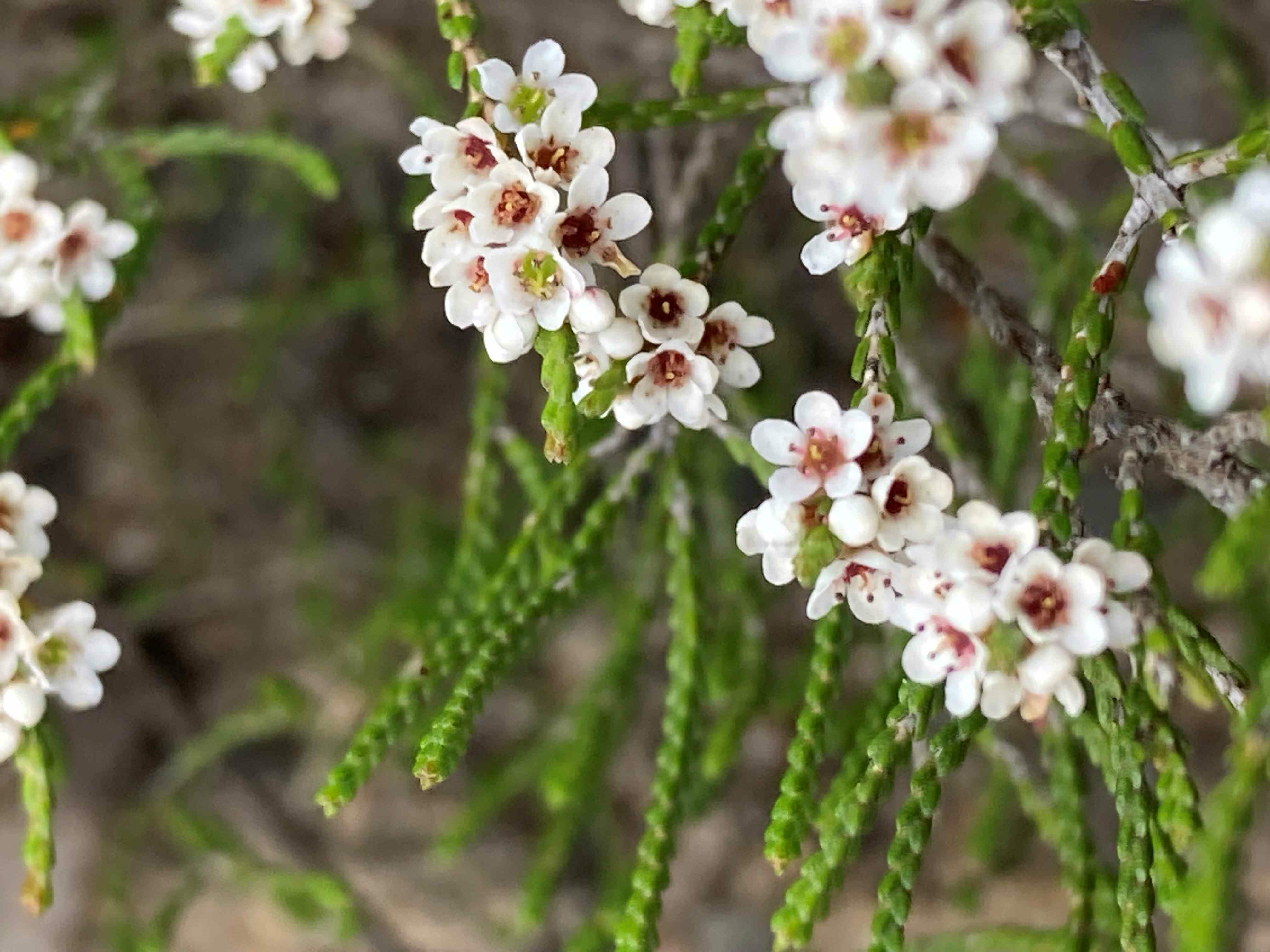 Micromyrtus sessilis (Janice Hughes)
After learning about the diverse Eucalypt Woodlands, whilst standing under Eucalyptus sieberi trees we looked at Gaudium blakelyi, which is dehiscent, is rare and restricted to the Lithgow area. Another Myrtaceae shrub of interest was Micromyrtus sessilis which likes rocky sites mainly in the ranges.
On the north facing heath, we found Patersonia sericea var. longifolia with spectacular purple flowers and the glaucous long leaves in a mass flowering.
Geological and climate influences can be seen by the diversity of the shrub layer too. The northern slope, with Eucalyptus oreades Woodlands supported a dense and large community of Banksia cunninghamii and a diversity of orchids. We were fortunate to see Caleana Major and Diuris sulphurea in flower.
After a splendid field trip we had a picnic lunch at Bracey’s Lookout which overlooks Lithgow.
Leader and Report: Meredith Brownhill
Photo: Micromyrtus sessilis by Janice Hughes
11 October - Banksia View vegetation survey Winmalee
Nineteen enthusiastic members of the PSG assembled on the 11th October in Winmalee to investigate the plants of Banksia View, Mark and Margaret Baker’s bushland property. We set out to follow an old fire trail that wound along the ridge through predominantly Corymbia gummifera – Eucalyptus sparsifolia Open-forest/Woodland. Nearly 6 years of above average rainfall had produced dense understorey growth and a diversity of October flowers was evident as we made our way north.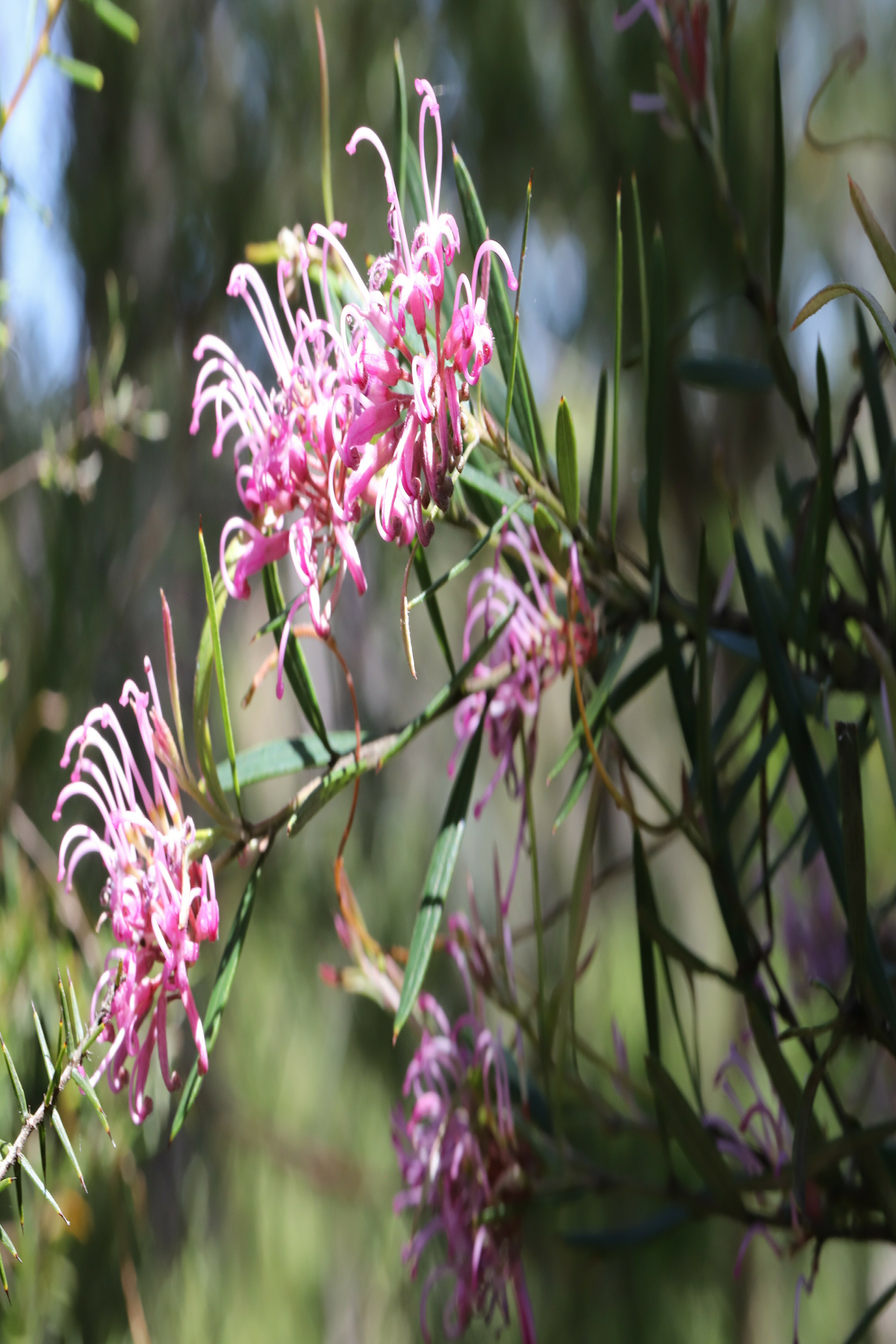 Grevillea patulifolia (Mark Baker)
Rumoured to be home to a number of Threatened plant species, we were on the lookout for something special and were soon delighted to discover the Vulnerable Leucopogon fletcheri subsp. fletcheri. Though its flowers had peaked in September, the forming fruit and prickly foliage of this tough plant made for ready identification. As the track ascended eyes were on the ground after the first sighting of the distinctive yellow and cobwebby Hibbertia superans was made. With its small stature and propensity to grow on bush tracks its Endangered status was not surprising. Then just a little further on where the plateau has shallow clay soil, we found a vigorous stand of yellow-flowered Pultenaea villifera var. villifera. The Blue Mountains representatives of this species are classified as an Endangered Population.
Around mid-day the temperature had started to climb and the wind was picking up so we decided to return. On our way we were reminded of a number of plants that were less familiar to some: the wide spreading canopy of Eucalyptus squamosa (Scaly Bark), stunning floral displays of Xylomelum pyriforme (Woody Pear), abundant yellow flower heads of Melaleuca nodosa (Prickly-leaved Paperbark) and the splashes of pink of the often mis-identified Grevillea patulifolia. A very colourful day.
Leader: Margaret Baker
Report: Margaret Baker
Photo: Grevillea patulifolia by Mark Baker
13 September - South Woodford
Eleven keen members enjoyed sunshine and biodiversity on a bush block in south Woodford. Sandstone soils supported Eucalypt woodlands with Corymbia gummifera, Eucalyptus oblonga, E. racemosa and E. sieberi. There was an understorey of low shrubs covering the block.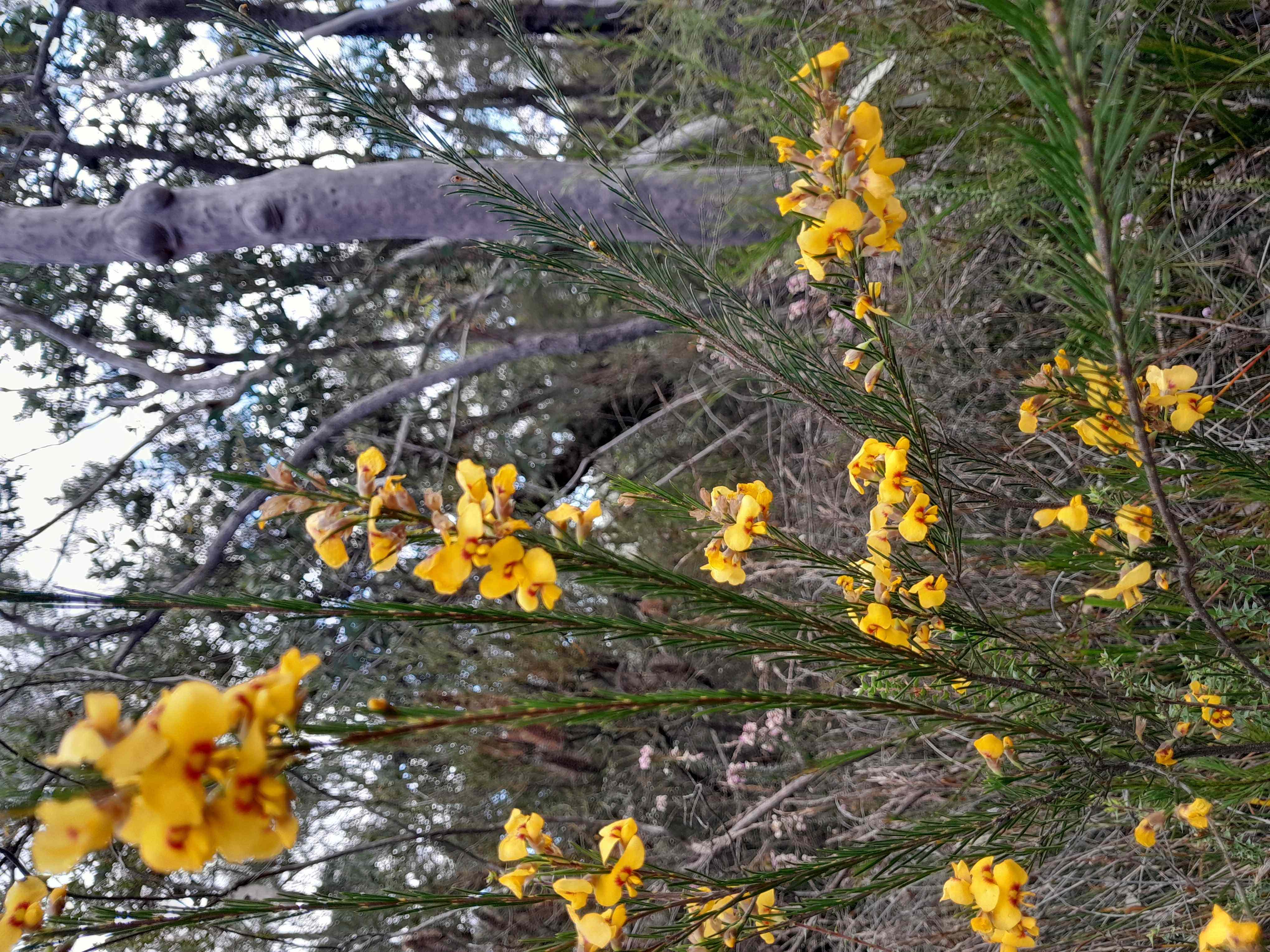 Dillwynia elegans (Jo Newman)
There were spring flowers of Dillwynia elegans and D. sericea. Epacris rigida and E. microphylla were in flower along with Woollsia pungens of the Epacridaceae Family.
We found Thelymitra ixioides in flower, the first orchid to flower on site this spring. We completed the morning outing with a sociable lunch.
Leader: Jelena Emmerick
Report: Meredith Brownhill
Photo: Dillwynia elegans by Jo Newman
12 July - West Glenbrook Nature Reserve
It was a perfect sunny morning after the rain, snow and wind of the last week when an enthusiastic group met at West Glenbrook. The soils here vary from shale to sandstone and so have a good range of plants, including several uncommon species. Goodenia caroliniana (Jill Dark)
As it was midwinter, there were not many flowers, but still plenty to see. The green flowers of Grevillea mucronulata were popular with a flock of Eastern Spinebills who were very annoyed with us for disturbing their meal.
Pterostylis nutans and Acianthus fornicatus were found almost hidden in the undergrowth, the only orchids found all day. As we descended towards the sandstone, the vegetation changed.
Micromyrtus ciliata and Calytrix tetragona were just coming into bloom and will look magnificent in a few weeks. The rare Dodonaea camfieldii and Goodenia caroliniana were also found. We had lunch under some Corymbia eximia trees and were pleased to see buds showing already.
As we slowly wandered back to the cars we all agreed it had been a very good day.
Leader: Jill Dark
Report: Jill Dark
Photo: Goodenia caroliniana by Jill Dark
14 June - Glen Davis. Capertee Valley bus trip
It was a frosty start to our bus trip up to Capertee Valley with its unique flora and fauna, and National Parks and State Conservation Areas. At Glen Davis we had a quick morning tea whilst identifying Eucalyptus albens and E. melliodora by leaves and woody fruits in the picnic area. Lomandra Briggsiana (Helen-Yoxall)
A small group of our members surveyed the Glen Davis picnic area and surrounds. A highlight was finding a flowering specimen of the newly (2023) described species Lomandra briggsiana, found on the Great Dividing Range and Western Slopes. This plant had formerly been considered to be a form of L. multiflora, but is distinguished from this species by its terete glaucous leaves.
The other group walked the start of the Pipeline Track in Open Forest. We admired the tall smooth bark - Eucalyptus dawsonii and the Red Ironbark – E. fibrosa. There was a sparse understorey with varied Acacias, such as Acacia clandullensis with its twisted leaf. This shale slope would have been denuded during the shale mining era prior to the 1950’s, so it was pleasing to find a healthy spreading population of Prostanthera cryptandroides subsp. cryptandroides with its very strong leaf aroma.
Leader: Meredith Brownhill
Report: Helen Yoxall and Meredith Brownhill
Photo: Lomandra briggsiana by Helen Yoxall.
24 May - Coates Park Bushcare Group, Hazelbrook
It was good to be in Eucalypt Woodlands in Coates Park, Hazelbrook looking at plants after a week of rain. Members of Plant Study Group teamed up with Coates Park Bushcare group to survey the flora on the bushcare site. Hackelia latifolia Coates Park
 Replanting the site with local native species is now underway after extensive removal of woody and ground layer weeds. A new native plant to the mid-mountains, Hackelia latifolia was observed with tiny white flowers and is a rapidly spreading plant so is being treated as a weed.
A healthy population of Pultenaea glabra was identified. This Pultenaea is found in riparian and swamp areas and is restricted to the mid and upper Blue Mountains. Its conservation status is Vulnerable under the BCA in NSW and EPBC Commonwealth legislation.
A very nice afternoon tea together completed an enjoyable plant survey.
Leader and report: Meredith Brownhill
Photo of Hackelia latifolia by Genevieve Powell.
10 May - 20th PSG Birthday - the Nature Walk, Wentworth Falls & joint twentieth celebration
 Celebrating the 20th birthday of Plant Study Group
(Janice Hughes)
There has been prolific growth in all the vegetation layers concurrent with warm and wet weather. The shrub layer had Daviesia corymbosa, Gompholobium grandifolium and Monotoca scoparia that will flower in spring. There is a healthy population of Banksia cunninghamii, although sadly some were cut down to widen the walking track near the Hut. Shrubs present will provide nectar for birds in cooler weather.
We all celebrated the 20th birthday of Plant Study Group at lunch with a fabulous birthday cake!
Leader: Alison Hewitt - Report: Meredith Brownhill
Photo of Plant Study Group: Janice Hughes
12 April - Mt Annan Botanic Gardens Bus trip
 Cumberland Plains Woodland Mt Annan
(Meredith Brownhill)
We walked through the Woodlands of shale loving vegetation, with a different species composition to the sandstone vegetation of the Blue Mountains. The canopy was Eucalyptus crebra, E. moluccana and E. tereticornis with many grasses and small herbs forming a dense ground cover.
The thrill of the day was seeing a large Lace Monitor climb a Stringybark. The butterflies were wonderful and we saw many Common Browns, Black Jezebels, Meadow-argus and Monarchs. They are all such important plant pollinators.
After lunch we walked in the Connections Garden, which was a delight of flowering shrubs.
Report and leader: Meredith Brownhill
Photo: Cumberland Plains Woodlands by Meredith Brownhill
22 February - Sun Valley Cabbage Gum Forest with Bushcare Group
 Plant group members at work in the Cabbage gum Forest
(Meredith Brownhill)
The Critically Endangered Sun Valley Cabbage Gum Forest is an Open Forest with Eucalyptus amplifolia which forms the upper canopy and has a smaller shrub layer with a dense ground cover of herbs and grasses. Ferns too are present. Eucalyptus amplifolia trees were plentiful, with narrow trunks indicating they were young and we guessed that mature trees were logged some time ago.
Being the end of summer there were not many flowers to help our identification task. Nevertheless we had an interesting and enjoyable afternoon at work and learnt about management of the reserve by talking to bushcare volunteers.
Report and leader: Meredith Brownhill
Photo: Plant group members at work in the Cabbage gum Forest by Meredith Brownhill
8 February - Ikara Ridge, Mt Victoria
 Isopogon anemonifolius
(Meredith Brownhill)
The Sydney Montane Dry Sclerophyll Forests that we walked through had severely burnt trees, with coppiced regrowth tree trunks from earlier fires. A dominant Proteaceae under-storey with Isopogon anemonifolius and Hakea pachyphylla had good growth with woody capsules on them from previous flowering seasons. H. pachyphylla is a rare plant endemic to higher altitudes.
Orchid species were identified and on a north facing slope plants such as Acacia asparagoides, A. terminalis and Dillwynia sp. were growing in a dense community. White flowers of Platysace Linearifolia were widely scattered throughout the Eucalypt forest.
A Copper-tailed skink sighting and sightings of other small reptiles, plus some rustles in the bushes indicated their recovery. We agreed that next field trip we will proceed to the heathland and explore other high altitude vegetation.
Leader: Jo Newman. Report: Meredith Brownhill. Photo: Isopogon anemonifolius by Meredith Brownhill
11 January - Perry’s Lookdown, Blackheath
 Lobelia dentata
(Janice Hughes)
The Eucalypt Open Forest is made up of E. piperita, E. racemosa – a Scribbly Gum and E. sieberi, The Fabaceae Family are the dominant community of under-storey plants at Perrys, which is to be expected after fire. Bossiaea ensata is interesting with its long flat stems, and leaves that are reduced to the size of scales. Acacia obtusifolia is a summer flowering wattle.
The Proteaceae family are another large under-storey community, Persoonia levis with yellow flowers and Lambertia formosa with red flowers look vibrant with new growth. We finished up with a happy lunch at a new picnic table.
Leader: Janis Hughes. Report: Meredith Brownhill. Photo: Lobelia dentata by Janice Hughes

We acknowledge the traditional custodians of this land
the Darug and Gundungurra people
and pay respect to their Elders past and present.