


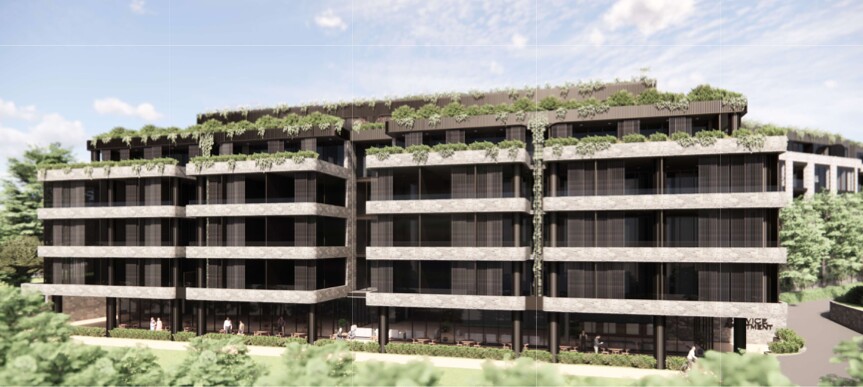
 Image of development from the EIS
142–150 Narrow Neck Road, Katoomba
There have been documented sightings of threatened species in the area of the proposed development (NSW Office of Environment and Heritage, 2026). It is also known that there is habitat for threatened species in the area (Australian Government Department of Climate Change, Energy, the Environment and Water, 2025). These species are listed under the NSW Biodiversity Act 2016 and or the Commonwealth Environment Protection and Biodiversity Conservation Act 1999. They may be listed as Vulnerable (V), Endangered (E), or Critically Endangered (CE), depending on the level of threat to their continued existence.
There are threatened species associated with the native trees and bushland on and adjoining the development site (see Table 1), as well as the waterways and swamps downslope from the site (see Table 2).
Native trees and bushland
| Threatened animals | NSW | C’WLTH | Habitat |
|---|---|---|---|
| Gang Gang Cockatoo (Callocephalon fimbriatum) | E | E | Nests in Eucalypts in small hollows 3m above ground. |
| Glossy Black Cockatoo (Calyptorhynchus lathami) | V | V | Feeds on Casuarina and Allocasuarina trees. Nests in hollows of Eucalypts. |
| Spotted-tailed Quoll (Dasyurus maculatus) | V | E | Uses hollow-bearing trees and fallen logs as den sites. |
| Grey-headed Flying-fox (Pteropus poliocephalus) | V | V | Can travel 20km from camps to feed on nectar and pollen of native trees close to water. |
| Threatened plants | |||
| Needle Geebung (Persoonia acerosa) | E | E | Dry forest and scrubby woodland on sandy soil. |
Table 1: Threatened species associated with native trees and bushland. Source: NSW Office of Environment and Heritage (2026).
 Figure 1: From left to right; Gang Gang Cockatoo, Glossy Black Cockatoo, Spotted-tailed Quoll, Grey-headed Flying-fox, and Needle Geebung. Source: NSW Office of Environment and Heritage (2026).
Other threatened species that use the area include the White-throated Needletail, Swift Parrot, Pilotbird, Powerful Owl, Sooty Owl, Little Lorrikeet, Brown Treecreeper, Varied Sitella, Scarlet Robin, Greater Glider, Yellow-bellied Glider, Koala, Eastern Pygmy-Possum and 8 species of bat, such as the Large-eared Pied Bat.
Threats
The main threats for the Gang Gang and Glossy Black Cockatoos, the Spotted-tailed Quoll, and Grey-headed Flying-fox are degradation and loss of habitat and food, through clearing for urban development. Weed invasion is also a threat to the Needle Geebung (Office of Environment and Heritage, 2026).
Waterways
| Threatened animals | NSW | C’WLTH | Habitat |
|---|---|---|---|
| Blue Mountains Water Skink (Eulamprus leuraensis) | E | E | Restricted to sedge and shrub swamps with boggy soils that are permanently wet, in the upper Blue Mountains. |
| Threatened plants | |||
| Dwarf Mountain Pine (Pherosphaera fitzgeraldii) | E | CE | Spray zones, drip lines and seepage areas of waterfalls in the upper Blue Mountains, eg Katoomba Falls. |
| Blue Mountains Cliff Eyebright (Euphrasia bowdeniae) | V | V | Wet sandstone rock faces on major cliffs facing south. In sandy soil on ledges that receive seepage moisture. |
Table 2: Threatened species associated with waterways. Source: NSW Office of Environment and Heritage (2026).
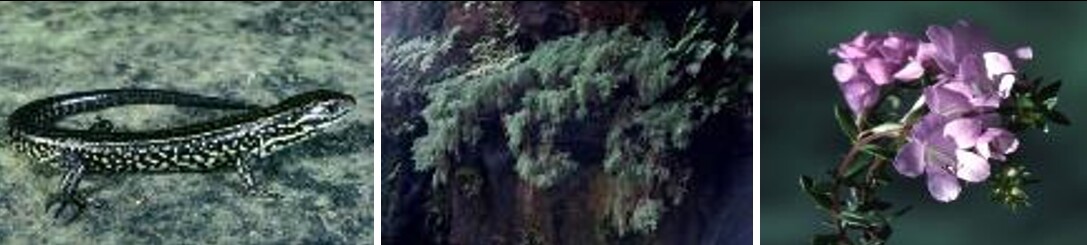 Figure 2: From left to right: Blue Mountains Water Skink, Dwarf Mountain Pine, Blue Mountains Cliff Eyebright. Source: NSW Office of Environment and Heritage (2026).
The Giant Burrowing Frog, Giant Dragonfly and Swamp Bush-pea are other threatened species dependent upon waterways and swamps in the area
Threats
The main threats for the Blue Mountains Water Skink, Dwarf Mountain Pine and Blue Mountains Cliff Eyebright are vegetation clearing and urban development which cause degradation and loss of habitat by:
- changing surface water flows; such as changes in stormwater and increased runoff
- reducing water quality for example through pollution of waterways
- erosion, sedimentation and run off from concrete surfaces which increases alkalinity of and nutrients in the soil
- weed spread
- changing groundwater levels, such as loss of groundwater recharge from perched swamp aquifers (Office of Environment and Heritage, 2026).
References
Australian Government Department of Climate Change, Energy, the Environment and Water. 2025. EPBC Act Protected Matters Search Tool.
https://www.dcceew.gov.au/environment/epbc/protected-matters-search-tool
NSW Office of Environment and Heritage. 2026. Bionet Atlas.
https://atlas.bionet.nsw.gov.au/UI_Modules/ATLAS_/atlasreport.aspx
NSW Office of Environment and Heritage. 2026. Threatened Biodiversity Profile Search.
https://threatenedspecies.bionet.nsw.gov.au/
You'll receive regular information and updates on the Society campaign to oppose this development, and its many other activities.

We acknowledge the traditional custodians of this land
the Darug and Gundungurra people
and pay respect to their Elders past and present.